From Hartford to Vietnam (Standard Edition)

Sale Price: $98.00 Original Price: $118.00

From Hartford to Vietnam: An Illustrated History of How Colt Brought the AR-15 to War

by Alex Young

*** This is a PRE-ORDER item. Printed books are not expected to arrive at our fulfillment center until approximately March 2027; however, this date is only an estimate and is likely to change to some extent. We will strive to post updates on the Updates Page of our website, so please check that page if you have status update questions. All images shown as part of this product launch are digital renderings of the current form of the book; however, some changes may be made to the appearance, content, and page count as we work through the print production process. Credit cards and payment methods will be charged at the time the order is placed. ***

Features:

  • Page count: 512 (approx.)

  • Each volume is 13" wide by 11" tall (approx.)

  • Commercial quality, section sewn binding which allows the book to lay flat

  • Full color prints on premium quality paper stock

  • Foil stamped, red faux leather hardcover

  • Ribbon page marker


From
Hartford to Vietnam: An Illustrated History of How Colt Brought the AR-15 Rifle to War is a journey through the development and production of the AR-15 by Colt’s Patent Fire Arms Manufacturing Company (later Colt Industries) and its ultimate fielding just in time for the growing Vietnam War. Though the AR-15 was the brainchild of Eugene Stoner and his team at the relatively small machine shop known as Armalite in Hollywood, California, it was American firearms icon Colt that purchased the rights to the rifle in 1959. From the small number of prototypes originally manufactured by Armalite (fewer than 30), Colt was faced with the seemingly impossible task of selling this new rifle concept to the US military and beyond.  

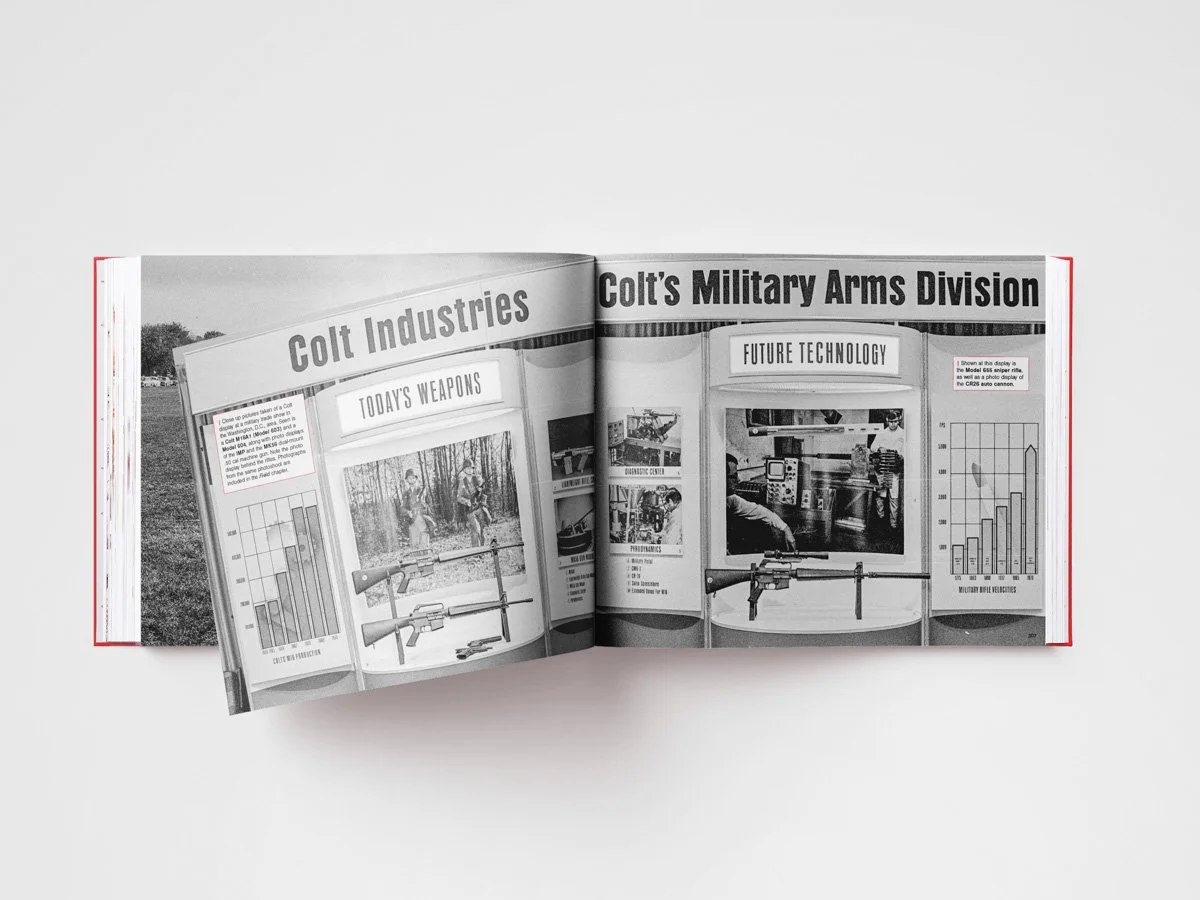
Authored by long-time Colt collector and historian Alex Young, From Hartford to Vietnam relies in large part on curated photographs that have been sourced by the author from a number of private collections, including from the estate of Rob Roy, a central figure in this story as a high-level employee at Colt during the development of the AR-15 throughout the Vietnam War period. This book contains over 570 images, the majority of which date to the 1960s and early 1970s. Most of the photographs have never been seen by the public.

From Hartford to Vietnam is divided into five main chapters – each telling an important part of this story:

  • Factory chapter: Rare views of the production and inspection areas at Colt, as well as Colt’s new rifle testing facilities built for the AR-15,

  • Guns chapter: An incredible array of photographs of weapons (many of which were experimental prototypes) taken in-house at Colt, with a heavy emphasis on the Model 602, 603, 604, 605, 606, 607, 608, Hybrid 607/608, M5, M2, LMG, experimental polymer receiver, CMG series, sniper rifles, grenade launchers, SP1, carbine variants, M16A1E1, M16A2, ACR, M16A3 Enhanced series, M231, and more.

  • Testing chapter: See Colt employees and US military officials at the range in a multitude of product demonstrations often firing the weapons seen in the prior Guns chapter.

  • Sales chapter: See Colt employees, US military officials, and politicians at trade shows and demonstrations of products, as Colt put forth its best efforts to sell the AR-15 family of weapons (and others) to militaries around the world.

  • Field chapter: Follow Colt employees Rob Roy and “Koni” Ito to the Vietnam War (and beyond), both to train troops in the use of new weapons (such as the XM148 grenade launcher) and to identify issues and problems being reported by troops in the field with the AR-15.

Additionally, an Appendix section at the end of the book presents a number of rare blueprints and additional documents.

From Hartford to Vietnam will become a valued addition to your library, whether you are a Vietnam War history enthusiast, or a serious collector of historically significant variants of the AR-15. The photographs and blueprints in this book are presented in incredible detail on large format, full-color prints in a premium hardback form.

From Hartford to Vietnam: An Illustrated History of How Colt Brought the AR-15 to War

by Alex Young

*** This is a PRE-ORDER item. Printed books are not expected to arrive at our fulfillment center until approximately March 2027; however, this date is only an estimate and is likely to change to some extent. We will strive to post updates on the Updates Page of our website, so please check that page if you have status update questions. All images shown as part of this product launch are digital renderings of the current form of the book; however, some changes may be made to the appearance, content, and page count as we work through the print production process. Credit cards and payment methods will be charged at the time the order is placed. ***

Features:

  • Page count: 512 (approx.)

  • Each volume is 13" wide by 11" tall (approx.)

  • Commercial quality, section sewn binding which allows the book to lay flat

  • Full color prints on premium quality paper stock

  • Foil stamped, red faux leather hardcover

  • Ribbon page marker


From
Hartford to Vietnam: An Illustrated History of How Colt Brought the AR-15 Rifle to War is a journey through the development and production of the AR-15 by Colt’s Patent Fire Arms Manufacturing Company (later Colt Industries) and its ultimate fielding just in time for the growing Vietnam War. Though the AR-15 was the brainchild of Eugene Stoner and his team at the relatively small machine shop known as Armalite in Hollywood, California, it was American firearms icon Colt that purchased the rights to the rifle in 1959. From the small number of prototypes originally manufactured by Armalite (fewer than 30), Colt was faced with the seemingly impossible task of selling this new rifle concept to the US military and beyond.  

Authored by long-time Colt collector and historian Alex Young, From Hartford to Vietnam relies in large part on curated photographs that have been sourced by the author from a number of private collections, including from the estate of Rob Roy, a central figure in this story as a high-level employee at Colt during the development of the AR-15 throughout the Vietnam War period. This book contains over 570 images, the majority of which date to the 1960s and early 1970s. Most of the photographs have never been seen by the public.

From Hartford to Vietnam is divided into five main chapters – each telling an important part of this story:

  • Factory chapter: Rare views of the production and inspection areas at Colt, as well as Colt’s new rifle testing facilities built for the AR-15,

  • Guns chapter: An incredible array of photographs of weapons (many of which were experimental prototypes) taken in-house at Colt, with a heavy emphasis on the Model 602, 603, 604, 605, 606, 607, 608, Hybrid 607/608, M5, M2, LMG, experimental polymer receiver, CMG series, sniper rifles, grenade launchers, SP1, carbine variants, M16A1E1, M16A2, ACR, M16A3 Enhanced series, M231, and more.

  • Testing chapter: See Colt employees and US military officials at the range in a multitude of product demonstrations often firing the weapons seen in the prior Guns chapter.

  • Sales chapter: See Colt employees, US military officials, and politicians at trade shows and demonstrations of products, as Colt put forth its best efforts to sell the AR-15 family of weapons (and others) to militaries around the world.

  • Field chapter: Follow Colt employees Rob Roy and “Koni” Ito to the Vietnam War (and beyond), both to train troops in the use of new weapons (such as the XM148 grenade launcher) and to identify issues and problems being reported by troops in the field with the AR-15.

Additionally, an Appendix section at the end of the book presents a number of rare blueprints and additional documents.

From Hartford to Vietnam will become a valued addition to your library, whether you are a Vietnam War history enthusiast, or a serious collector of historically significant variants of the AR-15. The photographs and blueprints in this book are presented in incredible detail on large format, full-color prints in a premium hardback form.

About:

Hugo Schmeisser’s name is synonymous with the development of some of the most influential submachine guns of the 20th century, yet myths and misinformation continue to obscure some of the fascinating real stories of their design. The Real Schmeissers offers an in-depth exploration of Schmeisser’s legacy, tracing the evolution of his iconic weapons from their origins in World War I through to their adoption and widespread influence across the globe.

Drawing on more than two decades of research, established small arms expert Bas Martens delves into Schmeisser’s career with the Bergmann company and C.G. Haenel, examining his pivotal role in the design and development of submachine guns such as the M.P. 18/I, the M.P. 28/II, M.P. 41, and others. This monumental book explores the intricate web of economic, industrial, and political factors that shaped the rise of these revolutionary weapons, describing key milestones in development, trials, adoption, export, and use, and considering Schmeisser’s significant international impact.

The Real Schmeissers examines a wide range of key firearms from the period, including:

  • Early submachine guns, including the Villar Perosa, Revelli–Beretta, Netsch, and Hellriegel

  • The first German SMGs, including converted Luger pistols, the Mauser Trench Carbine, and Walther designs

  • Schwarzlose

  • SIG and SIG Bergmann models

  • M.P. 18/I and variants

  • M.P. 18/II, M.P. 18/III, and M.P. 18/IV

  • Schmeisser pocket pistols

  • M.P. 28/II and its competitors (such as the Erma EMP)

  • M.K. 36/II and M.K. 36/III

  • M.P. 41

  • Local copies and derivatives, including the Spanish ‘Naranjero’, the Finnish Lindelöf, and the British Lanchester

Along the way, Martens traces the trials, adoption, and use of Schmeisser’s designs in German service, but also their widespread export and influence on foreign arms designers and military forces. The author also describes some of Hugo Schmeisser’s more exotic designs—such as a small-caliber training machine gun, and devices for echolocation and machine gun imitation—and looks at the significant variety of magazines and accessories associated with Schmeisser's submachine gun designs.

Illustrated with beautiful new photography—supplemented by rare archival images, blueprints, and patent diagrams—this meticulously researched book sheds light on fascinating stories of prototypes, trials, and foreign sales that have remained hidden until now. Appendices include a full parts list for the M.P. 28/II, with a German/English glossary for each component; key contracts translated into English; and several important Bergmann and Schmeisser patents translated into English, contextualized, and annotated. The text is fully referenced, and an extensive bibliography is provided to assist further research.

Richly detailed and lavishly presented, The Real Schmeissers offers an unprecedented look at the legacy of Hugo Schmeisser, his groundbreaking designs, and their enduring influence on global firearms development. This book is likely to stand as the definitive reference work on Hugo Schmeisser’s submachine guns for decades to come.